
This is a subject that is a part of every pet owner's life - how to handle a pet's last days.
My first dog I ever had to put to sleep was terminal with cancer. I asked my then Vet more than once, "How will I know when it's time?" and she always answered, "You'll just know". This was not at all helpful to me. When I did make the decision, I questioned myself right up to the emergency clinic.
I realize now that for me, this is normal. It is no small thing to end the life of a pet, even when you are doing it as a kindness to relieve suffering. Questioning my own judgment is not a bad thing.
Likewise, it is normal for me to look back and wonder if I made the decision at the right time. The only thing I refuse to dwell upon is "If I'd known then what I know now, the dog could have lived longer". I didn't know then what I know now just as I will (hopefully) know more in future. It's not fair to judge my past decisions on when to euthanize against a standard of knowledge I did not possess at the time. I won't beat myself up like that.
To get into some specifics, the dogs I've had to put to sleep have been Flatcoats. They have all been happy dogs who enjoy companionship but more than anything - food. I wish I could flatter myself by saying they valued my company more than life itself but that would be a lie. (Side note: I once took a nursing dam to the emergency Vet because she refused a meal. That's how much my Flatcoats have loved food. Turns out, she had mastitis.) So one factor that has been useful for me in deciding when to euthanize is whether the dog can be enticed to eat. When we reach the point that food is consistently refused, I know that dog is miserable.
I have never been of the mind to go for extensive treatment when a pet is terminal or simply old. Even if I won the lottery tomorrow, I don't think that would change. My pets are like most people's I would imagine - they don't like going to the Vet and definitely wouldn't like staying there for days. I can relate. I am a homebody and being at home gives me a sense of peacefulness and comfort. I think age increases the attachment to home and routines. I've been able to keep my pets at home until the final Vet visit was needed. I tend to think that would be their choice too, if they could be The Decider.
This is in no way meant to disparage owners who choose extraordinary measures and hospitalizations. Nor do I look down upon those who opt for a natural death, allowing the pet to starve himself or whatever the circumstances may be. We must each make the decision that is right for our situation and with our pet's best interests in mind. Aside from something extreme (e.g. a pet who has been badly mangled by a car and the Vet gives little hope for survival even if the owner opts for heroic measures), I don't think there are "wrong" end of life decisions for ailing pets. The best we can do is the best we can do.
One of the many things I've learned from my pets is to live in, and cherish, the moment. For me it's question=yes, regret=no.
What has been helpful to you in deciding when the time is right to euthanize a pet?
Showing posts with label general pet care. Show all posts
Showing posts with label general pet care. Show all posts
Thursday, March 4, 2010


Wednesday, March 3, 2010
Walking 10 Miles in the Snow to School Wearing Cardboard Shoes
I'm not elderly mind you but I am old enough to notice how much things have changed since I was a kid, particularly with regard to pets. For example:
When I was a kid...
Now I'm not saying that "only the old ways are right" by any means but it's interesting to note how attitudes toward pets seemed more common sense then than what we often see today. Then, we expected dogs to bite, especially chained dogs and those who were unsupervised around kids. It was an assumed risk. And on rare occasions, someone in the neighborhood did get bitten. But nobody's parents were running to the town council to ban the breed of dog who did the biting. Nor was the owner of the biting dog worried that authorities would seize and kill his dog. It was just a thing that happened. Like my neighbor cracking his head open after a bad fall off his bike (nobody wore helmets then) - we didn't have to all turn our bikes in to authorities, we were just supposed to "be more careful because this is what can happen".
Spaying and neutering pets was a convenience for owners who could afford it. We couldn't so we just safeguarded our dogs from unintentional breedings. And it was 100% successful, much to my dismay.
We fed our pets kibble but never questioned adding table scraps and sharing extra special bits on holidays and such. There either wasn't a massive blackballing effort against table scraps by the pet food and veterinary industries back then or if there was, it didn't reach our house. And the idea of taking a pet to the Vet for a dental cleaning or baseline bloodwork was utterly preposterous.
As I look over my little list, I think about how quick I am sometimes to judge how people care for their pets. I try not to jump to conclusions and yet, it happens. I wonder what the adult me would think about the kid me if I read about how my family took care of their pets in a blog post or online article. I hope I wouldn't be too quick to condemn because of course I thought then that we were good owners. I guess I still think that, even if my views have expanded and changed over the years.
What do you think about how you and your family raised your pets when you were a kid?
When I was a kid...
- We were told to stay well clear of the path of a chained dog.
- We were told that if we were riding our bikes and a loose dog came around, we should stop and walk the bike home because if we sped away, the dog would chase us.
- If a neighborhood kid got bit by a dog, that kid would likely be in trouble with a parent demanding to know what the kid did to provoke the dog.
- When our females came in heat, we could let them outside only when my Mom was there to supervise and then it was just for a quick potty break.
- Table scraps went into the dog bowl because "There are people starving in China and we don't waste food".
- The Vet was for giving rabies vaccines and putting pets to sleep when the time came. Sick pets were given a cardboard box with warm blankets in a quiet corner of the house, same as abandoned baby squirrels and injured birds. Mostly though, our pets were hale and hearty. At least that's the way I remember it now. The wildlife did not fare so well.
Now I'm not saying that "only the old ways are right" by any means but it's interesting to note how attitudes toward pets seemed more common sense then than what we often see today. Then, we expected dogs to bite, especially chained dogs and those who were unsupervised around kids. It was an assumed risk. And on rare occasions, someone in the neighborhood did get bitten. But nobody's parents were running to the town council to ban the breed of dog who did the biting. Nor was the owner of the biting dog worried that authorities would seize and kill his dog. It was just a thing that happened. Like my neighbor cracking his head open after a bad fall off his bike (nobody wore helmets then) - we didn't have to all turn our bikes in to authorities, we were just supposed to "be more careful because this is what can happen".
Spaying and neutering pets was a convenience for owners who could afford it. We couldn't so we just safeguarded our dogs from unintentional breedings. And it was 100% successful, much to my dismay.
We fed our pets kibble but never questioned adding table scraps and sharing extra special bits on holidays and such. There either wasn't a massive blackballing effort against table scraps by the pet food and veterinary industries back then or if there was, it didn't reach our house. And the idea of taking a pet to the Vet for a dental cleaning or baseline bloodwork was utterly preposterous.
As I look over my little list, I think about how quick I am sometimes to judge how people care for their pets. I try not to jump to conclusions and yet, it happens. I wonder what the adult me would think about the kid me if I read about how my family took care of their pets in a blog post or online article. I hope I wouldn't be too quick to condemn because of course I thought then that we were good owners. I guess I still think that, even if my views have expanded and changed over the years.
What do you think about how you and your family raised your pets when you were a kid?
Saturday, October 24, 2009
Food Porn, Part Three
Excerpt from the book British Dogs - Their Varieties, History, Characteristics, Breeding, Management and Exhibition by Hugh Dalziel (circa 1879)
(click images to enlarge)
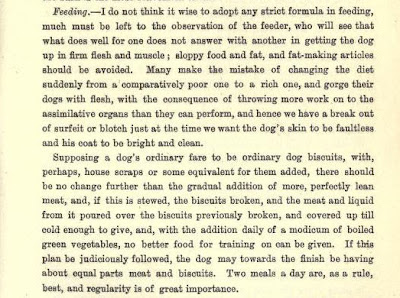

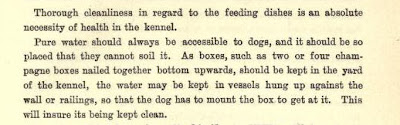
Previously in this series:
Food Porn (Part One)
Food Porn, Part Two
(click images to enlarge)
Previously in this series:
Food Porn (Part One)
Food Porn, Part Two
Sunday, June 14, 2009
Dog Ownership for Poor People
I'm sure this article was well intended. It was perhaps written to remind potential dog owners that nothing in life is free - even a free dog - and that there are financial responsibilities that come along with dog ownership. That said, I must offer my low/no cost alternatives to some of the expenses listed in the article:
Food and water bowls can be picked up from the Dollar Store (they don't have to say DOG on them yo) or you can use something from your own cupboard. Washing bowls regularly is more important than paying for ones with fancy designs. A slip leash (the kind I prefer) can be purchased very inexpensively. Your Vet might even be willing to sell you one if they have adequate supply. Toys depend very much on the individual dog (you don't want the dog ingesting the toy) but a few ideas: empty plastic milk jugs (can be tied together), raw beef bones, knotted up socks or other old clothing bits, empty water bottles. If you need a crate, try checking your local paper or one of the many online resources (like freecycle or craigslist) where folks pass on used household items at no/low cost. Crates are easily cleaned so as long as the condition is good, there is no need to buy a new one.
Healthy table scraps help me save on food costs because I share much of what I eat with the dogs and therefore, almost nothing goes to waste. For example, I may not finish the entire carton of eggs before the "sell by" date, but when I see it's getting close, I can hardboil the rest for the dogs.
Heartworm meds can be purchased at a far more reasonable cost than what the major brands go for, without a prescription, at your local feed store or online. HUGE savings right there.
Two thoughts:
If interested, you can learn to do at least a passable dog haircut yourself from books at the library or by searching for "how to" pages online. I used to groom a Toy Poodle that showed up in our yard one day. He wouldn't have won any beauty contests with my grooming but it kept him from turning into the Shaggy Dog.
Alternately, if you don't have the desire to give regular haircuts at home (I feel ya), you can get a dog that doesn't need them.
Related Reading: Straight Talk on How You Can Keep Your Dog During the Economic Crisis
Basic supplies: Food bowls, a leash and toys can cost $35 to $50 even if you restrain yourself. Crates can cost an additional $50 to $150, depending on the size.
Food and water bowls can be picked up from the Dollar Store (they don't have to say DOG on them yo) or you can use something from your own cupboard. Washing bowls regularly is more important than paying for ones with fancy designs. A slip leash (the kind I prefer) can be purchased very inexpensively. Your Vet might even be willing to sell you one if they have adequate supply. Toys depend very much on the individual dog (you don't want the dog ingesting the toy) but a few ideas: empty plastic milk jugs (can be tied together), raw beef bones, knotted up socks or other old clothing bits, empty water bottles. If you need a crate, try checking your local paper or one of the many online resources (like freecycle or craigslist) where folks pass on used household items at no/low cost. Crates are easily cleaned so as long as the condition is good, there is no need to buy a new one.
• Food: What you can expect to pay to feed your new pet will depend on the size of your dog and the quality of the food. A 15-pound bag of dry food from a well-known national brand should cost about $17 at a grocery store, and will last two to four weeks, depending on the size of your dog (an average of $225 to $450 per year). Canned, or wet, food tends to be more expensive.
Healthy table scraps help me save on food costs because I share much of what I eat with the dogs and therefore, almost nothing goes to waste. For example, I may not finish the entire carton of eggs before the "sell by" date, but when I see it's getting close, I can hardboil the rest for the dogs.
• Health care: Expect to pay $200 to $300 a year for nonemergency vet bills, including an annual exam and preventive care for common problems such as heartworm, fleas and ticks.
Heartworm meds can be purchased at a far more reasonable cost than what the major brands go for, without a prescription, at your local feed store or online. HUGE savings right there.
Grooming: Professional grooming services are a necessity for certain breeds.
Two thoughts:
If interested, you can learn to do at least a passable dog haircut yourself from books at the library or by searching for "how to" pages online. I used to groom a Toy Poodle that showed up in our yard one day. He wouldn't have won any beauty contests with my grooming but it kept him from turning into the Shaggy Dog.
Alternately, if you don't have the desire to give regular haircuts at home (I feel ya), you can get a dog that doesn't need them.
Related Reading: Straight Talk on How You Can Keep Your Dog During the Economic Crisis
Sunday, August 17, 2008
Straight Talk on How You Can Keep Your Dog During the Economic Crisis
If you are one of the many people facing hard times financially these days and considering giving up your dog due to the cost of maintaining a pet, this is for you. Here are some ways to save money in the short term until you get back on your feet financially - cos I do believe a change is gonna come.
1. Food - Many places already have pet food pantries which will supply food for your pet at no cost and more are springing up as we speak. Check with your local animal shelters to see if they have or know of a pantry in your area. Alternately, your dog can eat leftovers from your plate, provided you eat a relatively healthful diet. Cooked meats (trimmed of fat and bones), canned meats/fish, organ meats, rice, vegetables, oatmeal, eggs, yogurt, etc - make use of your healthy leftovers and table scraps to feed your dog. Yes, it's perfectly safe. Really. I've been doing it for years and so was every other dog owner prior to the introduction of widely available pet food to the market. For treats, raw carrots are great for chewing exercise - they will harmlessly pass through undigested as dogs can't digest whole, raw veggies. You can also use any leftover bits from the cupboard as treats: crackers that have gone stale, that bit of cereal left in the bottom of the bag, the crust of bread no one is going to eat...
2. Heartworm Meds - Heartworm preventive labeled for cattle is available at feed stores and online without a prescription. It has long been used "off label" as a canine heartworm preventive and the cost is dramatically cheaper than buying canine heartworm meds. Check with your Veterinarian to see if this is a recommended alternative for your dog if you are unable to afford the expensive meds right now.
3. Annual vaccines - Good news: they aren't needed for most dogs! Find out what your state's requirement is for Rabies revaccination and check with your Vet to see what, if any, other vaccines are recommended. Times have changed and it is now known that the immunity provided by many dog vaccines lasts longer than one year. So if your dog was previously vaccinated, he may not be due for revaccination this year and if you're in the midst of a financial crisis, certainly a "wellness exam" can be postponed until it's something that can be worked into the budget.
4. Spay-Neuter - Check with your area shelters to see if they operate or know of a low cost spay-neuter clinic. There are different kinds of clinics - some you have to demonstrate that you fall within certain income guidelines in order to qualify for the reduced fee services, others are open to anyone and everyone. Some require proof of recent vaccination for your pet, others do not so you'll need to ask these questions before making an appointment.
5. Dog Shampoo - If your dog is one that needs regular bathing, you are probably shocked at the price of dog shampoos - and rightfully so. What I use is the same as what I've used for years - even when I showed Champion titled dogs in dog shows - blue dishwashing liquid, original formula. I dilute it with at least 5 parts water to one part dishsoap and it works great. As with any shampoo, be sure to rinse every last bit out. If a conditioner is needed, anything that's on sale in the human shampoo aisle works fine. The cheaper, the better.
Subscribe to:
Posts (Atom)


 Posts
Posts


